Wheelchair Basketball Player
A Craft Fair Designer’s First Look: Bold, Uplifting, and Instantly Relatable
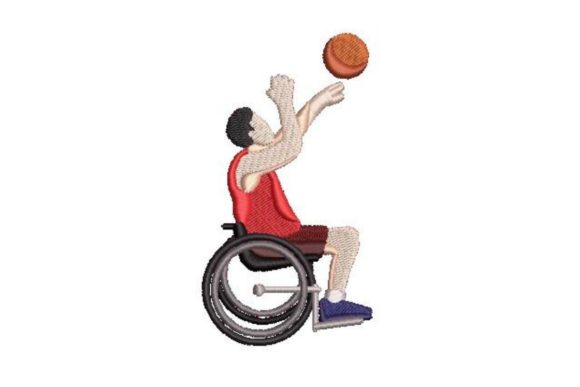
As an embroidery designer who’s prepped over 200 craft fair booths—from downtown pop-ups to regional handmade markets—I’ll tell you straight: Wheelchair Basketball Player lands with quiet confidence. It’s not loud or cartoonish; it’s bold yet warm, modern but approachable, and deeply human. The title alone signals inclusion, athleticism, and pride—three emotional hooks that resonate powerfully at a craft fair where shoppers seek meaning, not just merchandise. This isn’t just another sports-themed machine embroidery design. It’s a story stitched in thread.
Where It Shines on Handmade Products
In my booth setup—tote bags front-and-center, aprons draped over a wooden rack, tea towels folded beside embroidered patches—Wheelchair Basketball Player performs strongest as a medium-scale focal design. On a natural canvas tote bag (10”–12” wide), it reads clearly from six feet away: dynamic pose, clean silhouette, balanced negative space. As an apron embroidery, centered above the pocket, it adds personality without overwhelming function. On a linen tea towel? It works best when placed high on the hem—not too small, not too large—so the athlete’s motion reads cleanly against the fabric texture.
For smaller items, it’s selective but effective. As an embroidered patch (3.5”–4”), it holds detail beautifully—ideal for attaching to denim jackets, backpacks, or market bags. On a curved surface like a baseball cap? I’d recommend using it only on the front panel with light stabilizer and testing hoop placement first—avoid tight curves near the bill edge where distortion creeps in. As a pillow cover design or pouch front, it elevates a simple item into a conversation starter—especially among educators, adaptive PE coaches, and inclusive community groups.
What Makes It Sell at the Booth—and Online
At a craft fair, attention is currency. Wheelchair Basketball Player wins because it’s instantly legible, emotionally resonant, and photograph-ready. Unlike abstract motifs or dense script fonts, this design communicates its message in under two seconds—no squinting, no explanation needed. That’s gold for Etsy sellers scrolling through mobile feeds or boutique makers curating cohesive collections. Its clarity also makes it ideal for printable mockups: one clean photo of the design on a cream tote, a navy cap, and a charcoal apron gives buyers immediate context.
It’s also highly repeatable for batch production. With moderate stitch density (no excessive fill areas or micro-detail traps), it runs smoothly across multiple hoops and fabric types—key when you’re stitching 25 tote bags before Saturday morning. And because it avoids tiny lettering or intricate linework, there’s little risk of thread breaks or skipped stitches during high-volume runs.
Careful-Use Notes Every Embroiderer Should Know
- Dense stitch areas: Check the wheel rim and jersey folds—if the file includes heavy satin-stitched contours, use cutaway stabilizer on lightweight fabrics to prevent puckering.
- Fabric texture matters: On terry cloth tea towels or thick canvas market bags, reduce top tension slightly and verify stitch definition in your test run—textured surfaces can mute fine lines.
- Dark fabric warning: If stitching on black or navy, confirm thread colors are high-contrast (e.g., bright orange or white accents) and test visibility before final production.
- Small-size limits: Below 2.75”, details like facial expression or ball grip may blur. Stick to ≥3” for patches and ≥4.5” for tote bag fronts.
- Cap curvature: Avoid placing the full figure across the crown—it stretches and distorts. Center it cleanly on the front panel instead.
How It Strengthens Your Brand & Booth Presence
Wheelchair Basketball Player doesn’t just decorate—it positions. For small shop owners building a values-driven brand, it signals inclusivity, authenticity, and thoughtful curation. At the booth, it stands out among generic florals or clichéd slogans because it’s specific, dignified, and joyful. Paired with neutral-toned products (oatmeal canvas, slate denim, unbleached linen), it adds visual warmth without competing. And for Etsy sellers, it supports strong SEO alignment: “adaptive sports embroidery,” “inclusive tote bag design,” “handmade basketball patch”—all naturally supported by the design’s real-world relevance.
Practical Designer Notes Before You Stitch
- Always run a test stitch on scrap fabric matching your final product—especially for textured or stretchy materials.
- Check thread contrast early: what reads well on screen may disappear on dark fabric.
- Review spacing and proportions in your embroidery software—confirm limbs aren’t clipped at the hoop edge.
- Verify hoop size compatibility; if your primary hoop is 4×4”, ensure the design fits or has a scaled-down version.
- Inspect stitch density—look for overlapping fills or overly tight satin columns that could cause thread shredding.
- Match stabilizer type to fabric weight: cutaway for knits, tear-away for stable wovens, fusible for lightweight linens.
- Create at least one real mockup—not just digital. A stitched tote bag photographed in natural light tells buyers more than ten renderings.
- Compare how the design reads across multiple fabric colors—light vs. dark, solid vs. textured—to guide your product palette.
- Confirm commercial licensing before selling finished products—this is non-negotiable for Etsy sellers and wholesale partners.
Final Thought: More Than a Design—A Connection Point
In a sea of handmade goods, Wheelchair Basketball Player earns its place not because it’s trendy, but because it’s human-centered, production-smart, and booth-tested. It invites customers to pause, recognize themselves or someone they love, and carry that recognition proudly—on a bag, a cap, or a kitchen towel. For craft fair sellers, embroidery business owners, and creative entrepreneurs, that kind of resonance isn’t just nice to have. It’s what turns a casual browser into a loyal buyer—and a single design into a signature piece.